


Using a Total Communication Approach for Children with Speech and Language Delays

Research has shown that the use of a Total Communication approach can effectively increase the communicative abilities and vocabulary comprehension of nonspeaking children, as well as for those with complex speech, language and communication needs. This intervention approach embraces all forms of communication, including the use of gestures, signs, symbols, sign language (ASL), objects, pictures, verbal approximations, and aided AAC (e.g. communication boards, speech generating devices). Furthermore, research indicates that the use of sign language paired with spoken language can increase a young child’s verbal and communication skills.
As Pediatric Speech Language Pathologists, we collaborate with families to help identify and support your child’s preferred communication methods that match their current skill levels and communication abilities. Below, we have outlined some of the introductory signs and picture symbols that we suggest using with nonspeaking children, as well as with infants and toddlers with and without speech and language delays. We also describe how families can pair the use of these signs and picture symbols with spoken language, to help your young child more effectively communicate their wants/needs at home.
“More” Picture Support

The sign for requesting 'more' is an excellent early word and introductory sign for infants and toddlers. We enjoy using it in various ways and locations around the house when a child wants to ask for 'more' of a desired object or action. Children are likely to use this request during snack and mealtimes (especially with smaller food portions), playtime, and to request enjoyable actions they can't perform on their own (e.g., being tickled, having bubbles blown, or singing). This sign is also useful outside the house, such as at the park or playground, when your child might want 'more' pushes on a swing or 'more' turns down a slide. The sign for 'more' is a motor skill that babies can develop relatively early, similar to clapping, making it an ideal first sign to introduce to infants.
“EAT” Picture Support

We love to place this picture symbol that shows the ASL sign for ‘eat’ around common places where your child may be likely to see and request food. Examples are placing the picture on your refrigerator, closed snack containers, lunchboxes, and near your child’s high-chair or table setting where they typically eat for mealtimes. Whenever you and your child eat, you can model the use of this sign ‘eat’ as well as point to the picture of the ‘eat’ picture symbol. Once a child has mastered the use of the single sign (by gesturing, pointing to the symbol for ‘eat’ or saying/approximating the word, ‘eat’) you can then pair it with the sign and symbol for, ‘more’ to help your child communicate a longer two word request (“more” + “eat”).
“Give Me” Picture Support
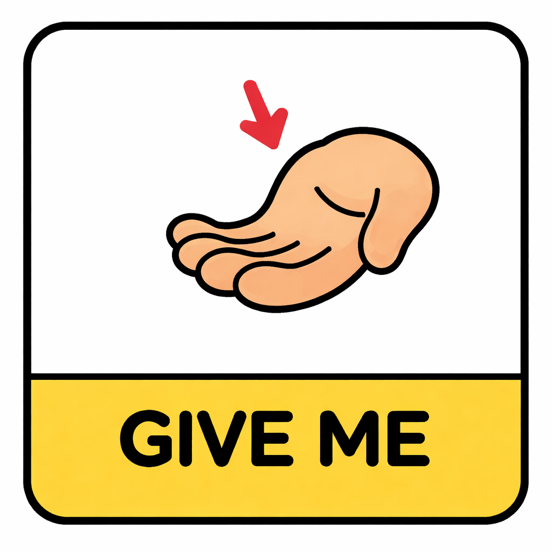
This universal sign and gesture for ‘give me’ acts as a visual cue ethat your child can use to request an item they want from somene else. When your child reaches to take something from your hand or a family member's hand (like a sibling) you can respond by saying, “Give me” while demonstrating this hand gesture and pointing to the picture of ‘give me’ if it's nearby. This is a useful gesture to teach other children that play with your child (e.g. siblings, cousins, etc.) so they can also model the use of the sign and words during playtime when sharing toys. While playing with your child, you can also model the use of this phrase to ask for toys they are holding. We place this picture in visible locations such as common play areas and dining areas. During snack and mealtimes, you can model the use of this gesture and phrase when you hold a desired drink or snack item that your child may want. You can also model the use of this sign and gesture with other family members so your child can learn from you making this request from others!
“HELP” Picture Support

We like to place this picture symbol for ‘help’ in visible areas (at your child’s eye level) where they might need adult assistance. Consider placing these pictures on the refrigerator and dining table, near containers that your child needs help opening (e.g., drink bottles, toy containers), in the bathroom, in play areas at home, on their clothing dresser, and next to their shoes/coats. This offers numerous opportunities throughout the day to model using this word and provides your child with a visual reminder to use words or gestures to express their needs. We also demonstrate this sign, along with the word “help,” when children take our hands or point to items they want but cannot reach. Remember, if your child points to the picture of ‘help,’ that is their preferred way of communicating this word, and you can respond by acknowledging their communication efforts by saying, “Help…you want help!”
ABOUT US:
Sunny Spot Speech provides private speech therapy services and evaluations for kids in home, online, at your child's preschool, daycare, private school, or at another community location throughout Los Angeles' San Fernando Valley. We have an incredible and growing team of bilingual (Spanish and English speaking) Los Angeles based Speech Language Pathologists who are knowledgeable in the assessment and treatment of a wide range of communicative disorders, including (but not limited to) children with Language Disorders and Developmental Delays, Hearing Loss, AAC users, Fluency disorders, Articulation and Phonological Disorders, Childhood Apraxia of Speech, and Gestalt Language Processors.


Comments