


using AAC core words For children with speech and language delays

In an earlier blog post we highlighted some introductory signs and visual aids we often use with non-speaking children and with infants, toddlers and preschool-aged children as part of a Total Communication approach to speech and language therapy. Research has shown that the use of a Total Communication approach can effectively increase the communicative abilities and vocabulary comprehension of nonspeaking children as well as for children with complex speech, language and communication needs. A Total Communication approach values all modes of communication, including the use of gestures, signs, symbols, sign language (ASL), objects, pictures, verbal approximations, and aided AAC (e.g. communication boards, speech generating devices).
Below are some more early signs and core vocabulary word picture-based supports that may help your nonspeaking child better communicate their wants and needs at home. When children use any form of AAC (Augmentative and Augmentative Communication), ‘Core Words’ refers to the essential vocabulary words that form the basis of functional communication. Think of these as the words that we frequently use to express our basic wants and needs, protest, and make requests. A few examples of core vocabulary words include: stop, go, more, yes, no, open, want, more. Numerous visual aids (pictures) for each of these 'core words' are available online. While you can choose any picture or symbol that suits your family and child best, we recommend using the same picture consistently to help your child develop a spoken word/picture association.
Yes/No

When modeling the spoken words ‘Yes’ and ‘No’, we simultaneously use the head nod gesture while saying, ‘Yes’ and side-to-side head shaking gesture while saying ‘No’ - in addition to pointing to the corresponding visual aids. When you are first teaching your child to answer ‘yes/no’ questions (by speaking, gesturing, or pointing to a picture), try to identify something that they love and will be motivated to request. For example, during meal times if you know your child prefers a certain food (e.g. goldfish) show it to them and ask, “Do you want goldfish?” If your child looks at, points to or reaches for the food, model the word ‘Yes’! with an exaggerated head nod and touch the green check mark picture before giving them the goldfish snack. Place your ‘yes/no’ visuals within your child’s reach so they can easily touch or point to them while you model these words during mealtimes. Once your child shows an understanding of the word, ‘yes’, you can then model the word ‘no’ visual by offering a food option that you know your child typically does not like.

Apart from meal and snack times, another opportunity to teach concrete ‘yes/no’ questions is during your child’s favorite activities that require your assistance. For example, when blowing bubbles, playing with water, tickling/hugging, or pushing them on a swing. You can show them the yes/no visuals and ask, ‘Do you want more + desired action?’ while waiting expectantly. Make sure that your child is able to comprehend and answer concrete yes/no questions (e.g. “Do you want/need…”) before introducing more abstract questions (e.g. “Is this a dog?” while pointing to a picture of a cat).
Open
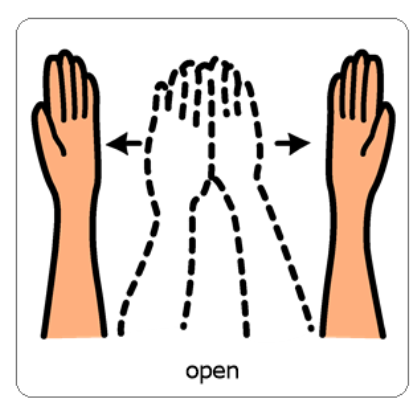
We love teaching the sign for ‘open’ alongside picture-based supports, because older infants can usually coordinate their motor skills to closely imitate this sign. Additionally, toddlers and preschool-aged children often require frequent adult assistance to open containers, making this a practical early word to model and use regularly with your young children. This helps them initiate more independent requests and better communicate their wants and needs at home.

Here are some tips for introducing and modeling the sign and word ‘open’ at home:
1. Store children’s favorite toys in clear/transparent bins or containers that are challenging for them to open, and attach the picture-based cue for ‘open’ on the outside to encourage them to ask you to ‘open’ it
2. Store your children’s snacks in containers that are difficult to open as well, and place the ‘open’ picture on their lunchbox and in their eating areas such as their table setting or on their highchair
3. You might already have ‘open door’ toys and ‘lift-a-flap’ books, which you can use to model the word ‘open,’ Take turns opening doors to uncover toys or pictures hidden behind them, while using this picture and sign.
4. Each time you open doors in your home or car, demonstrate the sign and word for 'open' as you open the door for your child. We recommend placing the 'open' visual at your child's eye level on doors they often open in your house, such as bedroom and bathroom doors, refrigerator doors, and cupboard and pantry doors.
Want

This is a crucial core word for teaching your child to express a desire for something. When you notice your child wants something (e.g. by pointing towards a desired toy, leading you towards a desired item or place, or reaching/grabbing for an object), you can encourage them to use this functional word, sign and/or picture to make a request.
Once your child understands the word 'want', you can help them increase their utterance length by introducing the carrier phrase 'I want + noun/verb', using picture-based supports as well. A simple way to teach this word and phrase at home is by giving your child two options and asking, 'Do you want NOUN or NOUN?' Hold up two different snack items or toys (one preferred and one non-preferred) and observe which object your child seems more interested in (by watching their eye gaze or waiting to see which toy/food item they reach for). Keep the visual cue 'want' nearby when offering choices and model the phrase and sign for 'want + noun' before giving your child their selected choice.
Stop & Go
The word ‘stop’ is important for your child to learn early in life. Understanding the word ‘stop’ is vital for children, particularly for safety, but it also allows a child to protest and make requests for activities to be discontinued using their words instead of through actions or behaviors. Create situations that may encourage your child to use the word ‘stop’ to ask for an activity to end. For instance, try playing with a toy that your child is using. If they seem annoyed or frustrated, prompt them to use the word ‘stop’ (by signing, saying or pointing to the image) and then immediately discontinue the action.

The word “Stop” pairs well with “Go” with, especially when engaged in movement related activities and interactive play with your child. Demonstrate the use of ‘stop’ and ‘go’ when swinging, playing with toy cars, turning music toys ‘on’ and ‘off’ and engaging in dancing games (where you freeze when the music stops playing). Use the word ‘go’ to initiate positive actions, such as blowing bubbles, pushing your child on a swing, or turning on music or videos.
ABOUT US:
Sunny Spot Speech provides private speech therapy services and evaluations for kids in home, online, at your child's preschool, daycare, private school, or at another community location throughout Los Angeles' San Fernando Valley. We have an incredible and growing team of bilingual (Spanish and English speaking) Los Angeles based Speech Language Pathologists who are knowledgeable in the assessment and treatment of a wide range of communicative disorders, including (but not limited to) children with Language Disorders and Developmental Delays, Hearing Loss, AAC users, Fluency disorders, Articulation and Phonological Disorders, Childhood Apraxia of Speech, and Gestalt Language Processors.


Comments